Appetizer or Tapas? The Difference Is Bigger Than You Think
Somewhere between the first Spanish restaurant that opened in a US strip mall and the thousandth "tapas-inspired" menu that followed, something got quietly lost. The word tapas stuck around. The philosophy behind it didn't.
If you've ever ordered a round of "tapas" at an American restaurant and walked away feeling like you just ate a slightly fancier version of bar snacks, you weren't wrong to feel confused. What you were probably eating was closer to appetizers dressed up in Spanish clothing. And that distinction — small as it might sound — changes everything about how you eat, how you host, and what you're actually trying to create when you bring that energy into your own kitchen.
What Makes an Appetizer an Appetizer
In American dining culture, appetizers exist to serve one function: to get you ready for the main event. They arrive before the entrée, they're typically ordered by the individual, and they're designed to whet your appetite without satisfying it. A shrimp cocktail, a spinach artichoke dip, a plate of nachos — these are all appetizers. They're opening acts.
The implicit message of an appetizer is hold on, the real food is coming. That framing shapes everything — the portion size, the flavor intensity, even the way the server talks about the menu. "Would you like to start with something?" is the question, and the answer is always understood to be temporary.
Tapas don't work that way. They never did.
The Actual Point of Tapas
In Spain, tapas aren't the warm-up. They are the meal — or more accurately, they're the format through which a meal, a conversation, and a couple of hours of your evening unfold together. The word itself traces back to a humble origin: a small plate or lid placed over a drink to keep flies out, often topped with a bite of something to eat. Practical, unpretentious, and deeply social.
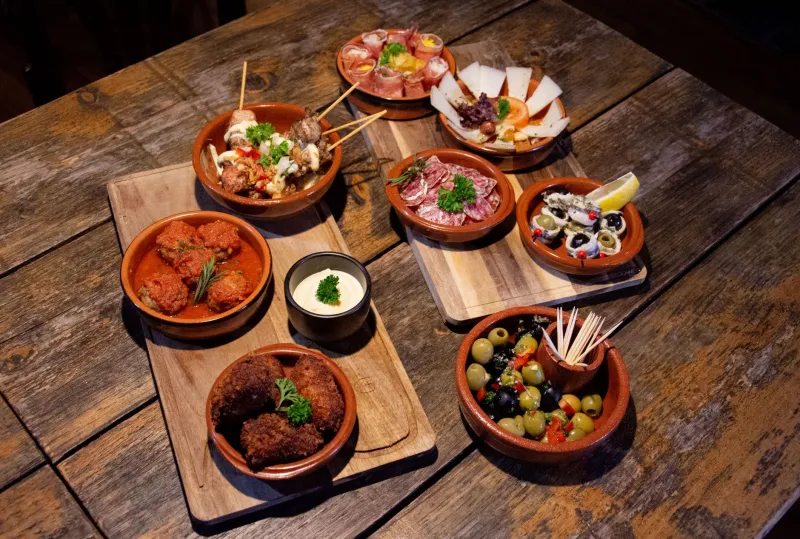
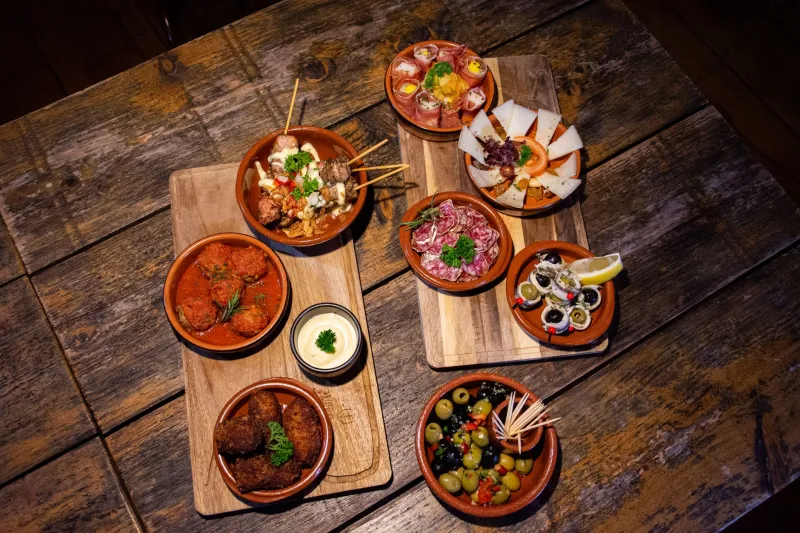
What evolved from that tradition is a way of eating that's fundamentally communal. Multiple small plates arrive at the table and are shared by everyone. Nobody orders their own. Nobody waits for permission to reach across. The spread builds gradually, the conversation flows between bites, and the whole thing moves at a pace that American dining culture finds genuinely uncomfortable: slowly, on purpose.
That unhurried quality isn't accidental. It's the whole point. Tapas culture is built on the idea that eating together is worth lingering over — that the table is a place to stay, not a stop on the way to somewhere else.
How US Restaurants Muddied the Waters
When the tapas trend hit the American food scene in earnest — somewhere around the late '90s and early 2000s — restaurants were quick to adopt the aesthetic without fully importing the ethos. Suddenly, menus everywhere featured "small plates" presented with a certain Spanish flair: jamón here, Manchego there, maybe some patatas bravas if you were lucky.
But the structure underneath was still very American. Plates were portioned for one. The server still asked if you were ready for your entrée. The kitchen still operated on the assumption that these small bites were a prelude, not the main attraction. And the prices — oh, the prices — were set as if each plate were a stand-alone course rather than one piece of a larger, shared puzzle.
The result was a hybrid that satisfied neither experience. You paid tapas prices, but you ate in an American rhythm. You got the visual of a Spanish spread without the social architecture that makes it meaningful.
Home cooks absorbed this distorted version and brought it back to their own tables. "I'm doing tapas tonight" started to mean "I'm making a bunch of small dishes before dinner" — which, again, is just appetizers with extra steps.
The Three Things That Actually Separate Tapas From Appetizers
If you want to cook and eat the real thing, here's what to hold onto:
Tapas are the meal, not the preamble. There's no entrée waiting in the wings. The spread of small plates is dinner. That means you need enough variety and volume to actually feed people — not just tease them.
Sharing is non-negotiable. Individual portions defeat the purpose. Part of what makes tapas work is that everyone at the table is eating the same things, reaching for the same plates, tasting and reacting together. That shared experience is what turns a meal into a moment.
Pacing matters more than quantity. Authentic tapas don't all land on the table at once. They come out in waves, giving people time to eat, drink, talk, and decide what they want next. If you're hosting at home, resist the urge to put everything out simultaneously. Bring things out gradually. Let the table breathe.
What This Means for Your Kitchen
The good news is that once you understand the difference, you don't need to overhaul your cooking skills to get it right. You need to overhaul your mindset.
Stop thinking about tapas as a category of dish and start thinking about them as a mode of eating. A perfectly fried egg on toast with good olive oil and a pinch of smoked paprika can be tapas. A bowl of olives and some sliced cured meat can be tapas. What makes them tapas isn't the recipe — it's the intention behind how they're served and shared.
That means slowing down. It means setting the table for a long night rather than a quick meal. It means buying a bottle of something Spanish to sip between plates and letting the conversation dictate the pace of the food, not the other way around.
It also means letting go of the idea that you need a dozen complicated dishes to pull it off. Two or three well-chosen plates, served with genuine hospitality and no rush, will always outperform a sprawling spread that everyone eats in fifteen minutes before moving on to the main course.
Recognizing the Trap When You're Out
Next time you're at a restaurant billing itself as a tapas spot, here's a quick gut-check: Are the plates sized for sharing or for one person? Is there a main course section on the menu? Does the server seem surprised when you say you're ordering multiple rounds rather than one pass through the small plates?
If the answer to any of those is yes, you're probably looking at appetizers in disguise. That's not necessarily a dealbreaker — plenty of those restaurants serve genuinely good food. But go in with clear eyes. You're not in Spain. You're not even that close.
The real thing is worth seeking out and, better yet, worth building at home. Once you've felt the difference — the unhurried pace, the easy back-and-forth, the way a two-hour meal over small plates feels more satisfying than a three-course dinner ever could — the imitation stops being enough.
That's the tapas trap. And now that you see it, you can't unsee it.